Introduction
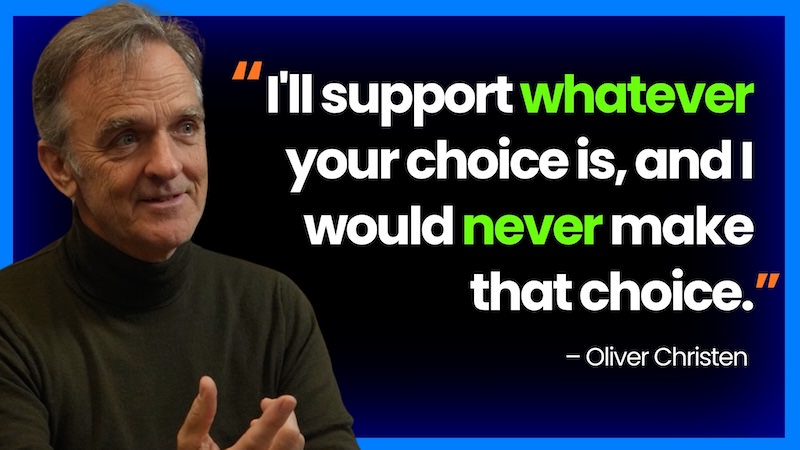
Oliver Christen spent 24 days sitting beside his mother as she chose exactly how she wanted to die. On paper, it sounds like a story about death. In reality, it’s about aging, independence, and the quiet heartbreak that arrives when a fiercely capable person feels their world begin to shrink. Oliver’s mother had lived a full life: she escaped Eastern Germany as a child, worked as a doctor and medical researcher, raised a family in Switzerland, and competed in cross-country ski marathons into her 80s. When she could no longer live with the independence she valued, she made a conscious decision to stop eating and drinking, a practice called a death fast, and asked her son to walk beside her.
This episode sits down with Oliver to talk about those 24 days, what he learned, and why the earlier we have these conversations, the more fully we get to live.
Why this conversation matters
Most men will, at some point, sit in a hospital corridor arguing with siblings about what a parent would have wanted. Oliver’s story shows what it looks like when that conversation happens decades early instead. His mother had belonged to Exit, the Swiss voluntary assisted dying organisation, for 15 years. But for her own end, she chose something different: a voluntary stop to eating and drinking, guided by five criteria drawn from Hindu tradition, including whether she had lived fully, still had purpose, and had told her family and received their blessing. Oliver was with her for all 24 days. It’s not a story of giving up. It’s a story of a woman completing her life on her own terms, and a son learning the most loving thing he could do was often nothing at all.
What we discuss
- What a death fast is, how it differs from voluntary assisted dying, and the five criteria that told Oliver’s mother she was ready
- How she let go of her identity piece by piece, finishing with a final 10 kilometre ski race at 82
- The hardest of the 24 days, when Oliver felt completely helpless, and what a stray cat taught him
- Why writing letters of gratitude now, rather than saving them for a eulogy, changes the way you live
- How to start the conversation with an aging parent about how they want to be cared for
Why midlife men should listen
Most men are taught to do something when things get hard. Fix it, fight it, fund it. Oliver’s story is about the opposite instinct: learning to sit still, stay present, and let someone else’s process unfold without trying to control it.
If you have an aging parent, or you’ve never had the conversation about what a good ending looks like, this gives you a real starting point. It’s not morbid. Oliver and his mother laughed, drank champagne through a mist spray, and watched sunsets together in those final weeks. It’s one of the most life-affirming conversations we’ve recorded.
Guest info

Oliver Christen
Oliver Christen is a Zurich-based leadership consultant and author, working at the intersection of capital, leadership and human development through his firm, PEAQ Partners. He spent 24 days supporting his mother through a death fast, a voluntary stop to eating and drinking, after she decided she was ready to complete her life on her own terms. That experience became his memoir, As She Chose, exploring end-of-life choice, family and what it means to die well.
Oliver studied at the University of St Gallen and has spent his career working with executives and leadership teams across Europe on culture, transformation and conscious leadership. He now writes and speaks about death literacy, aging and the conversations families too often leave too late.